the woman who saw them as twins
Alice Catherine Evans
Alice Evans arrived at the Bureau of Animal Industry in Washington in 1913 through what she later described, with characteristic dryness, as a loophole. The BAI was male territory. Only one woman scientist had preceded her there, and she had already left. The bureau's officials had simply failed, as she put it, "to protect themselves against the admittance of a woman." When the news reached a staff meeting, she was told, they almost fell off their chairs.
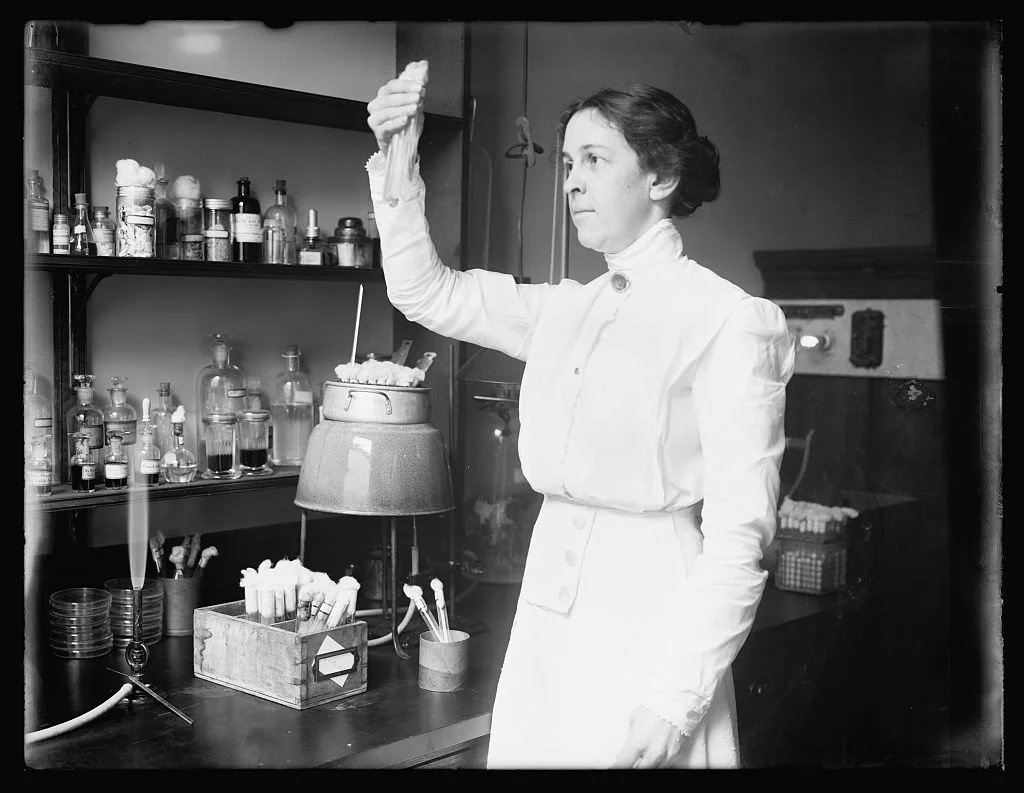
Alice Catherine Evans (1881-1975), at her laboratory in the Dairy Division, Department of Agriculture, between 1910 and 1920.
image credit: Library of Congress, National Photo Company Collection
Evans was assigned to the Dairy Division, studying the bacteria in freshly drawn cow's milk. She found herself drawn to one organism in particular: Brucella abortus, the cause of spontaneous abortion in cattle, which lived silently in the udders of cows that appeared perfectly healthy. The idea of drinking milk contaminated with bacteria capable of causing disease in animals was, as she later wrote, distasteful to her. She wanted to know more. A colleague pointed her toward Micrococcus melitensis, the organism confirmed to cause undulant fever in humans, which lived silently in the udders of apparently healthy goats in exactly the same way. Evans obtained six strains and went back to her bench.
simply amazed
What happened next she described in her memoirs with uncharacteristic simplicity: she was amazed. The two organisms had been discovered by different researchers on different continents decades apart and classified into entirely different genera. One was a bacillus, found in cattle. One was a micrococcus, found in goats and humans. But they behaved identically in every cultural test she ran. Years later, dramatizing her story for a 1947 radio broadcast, she would describe what she saw as simply as possible: they were twins.
To confirm her findings, a pregnant cow was inoculated with the goat organism. Forty-six days later she aborted, and the same bacteria was cultivated from the fetus. The species barrier, in both directions, was permeable.
That nobody had noticed this before was not a failure of intelligence. Bacteriology in 1916 was only a few decades old, its researchers still working out basic questions of method, tools, and classification. David Bruce had classified Micrococcus melitensis as spherical because under the microscopes available to him, the shorter cell forms genuinely looked round. As Evans later wrote, the cells were rod-shaped but divided into varied lengths, "some so short that under the microscope they appear to be round." In a new field, it was the cost of going first. The taxonomy that followed made comparison unthinkable: it would have been heresy, as Evans noted, to suggest a relationship between a micrococcus and a bacillus. So nobody suggested it.
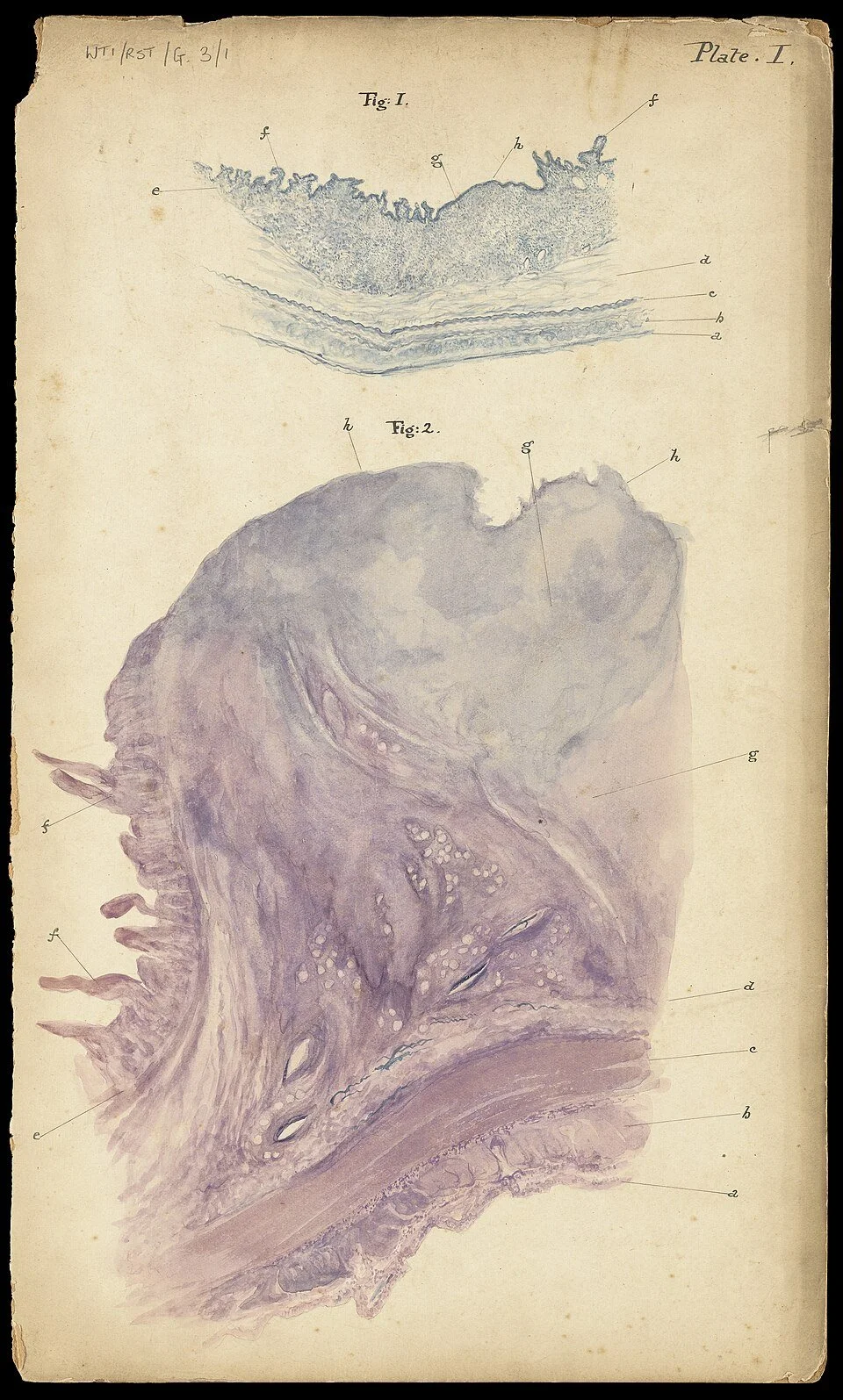
Watercolours of micrococcus, by Lady Mary Bruce OBE
image credit: Wellcome Collection. CC BY 4.0.
In December 1917 Evans presented her findings to the Society of American Bacteriologists. In July 1918 she published them in the Journal of Infectious Diseases, closing with a question she had clearly been working toward: "Are we sure that cases of glandular disease, or cases of abortion, or possibly diseases of the respiratory tract may not sometimes occur among human subjects in this country as a result of drinking raw cows' milk?"
The reaction was almost universal skepticism. Evans was unmoved. "This was not valid criticism," she wrote later, "and it did not disturb me, for with only a few hours of work any bacteriologist who had cultures of brucellae at hand could test the accuracy of my report. I knew someone would do this before long."
a very large claim
The most prominent voice against Evans was Theobald Smith, arguably the most distinguished American bacteriologist alive, and a scientist who had himself warned of the possible human health implications of Brucella abortus in cow's milk as early as 1912. He was not ignorant of the possibility, but he was concerned, Evans noted, about the economic consequences for certified milk producers. And there was the matter of what it meant to be publicly wrong. "I was a newcomer in a field where he was regarded as an authority," Evans wrote, "and he was not accustomed to considering a scientific idea proposed by a woman." All of it was operating at once.
When Evans consulted her director about Smith's opposition, he told her consolingly that truth would prevail. She replied that a man of Dr. Smith's stature could delay recognition of the truth for years.
"truth will prevail"
She was right about the delay. She was also right that it wouldn't hold. Confirmation came from Karl Meyer in San Francisco in 1920. Within four years, ten more investigators in eight foreign countries had confirmed her findings, and the genus Brucella was proposed and named, unifying under a single taxonomy the organisms Evans had identified as related. In 1925 Smith declined to chair a National Research Council's Committee on the subject, citing his ongoing work showing the organisms were not identical. By 1929 he was still publishing lingering doubts while investigators in Ohio and Iowa were simultaneously reporting hundreds of confirmed human cases traced to cow's milk. The floodgates, as one contemporary put it, were open.
Evans's finding was possible because of where she was standing. The gap between veterinary and human medicine was not yet a gap anyone was looking into. It was simply the edge of each discipline's map. She was positioned, partly by training and partly by accident, at exactly the intersection nobody with more institutional standing had thought to occupy. The findings that require two fields to speak to each other are often ones that matter greatly, and often ones that move slowly, not because the evidence is weak, but because the existing architecture of knowledge has no room for someone standing at the boundary.
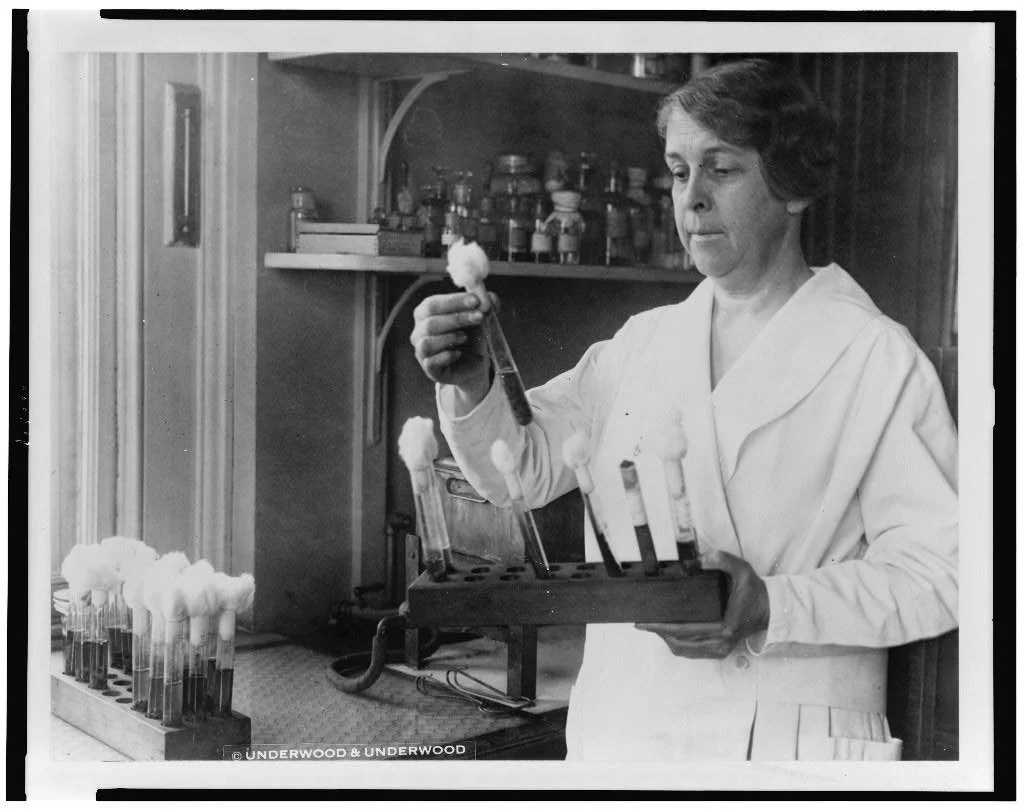
Alice Catherine Evans (1881-1975), at her laboratory in the Washington, DC, 1928.
image credit: Library of Congress, National Photo Company Collection
living inside it
In October 1922, while working intensively with cultures from an outbreak in Phoenix, Evans contracted brucellosis. She was as careful as she knew how to be, but no one yet knew that the precautions adequate for other bacterial diseases offered no protection against brucellae, which could infect through the respiratory tract.
What followed was twenty-three years of intermittent illness. Years later, participating in a 1947 radio dramatization of her story, she described the disease from the inside: "this tricky disease that tires you, so that sometimes you have a fever, and sometimes you don't, so that it's hard to diagnose just what's wrong." It was this diagnostic ambiguity that had allowed the medical establishment to dismiss the disease for years.
“personal heroism of the highest order”
On December 30, 1927, the Society of American Bacteriologists elected Evans their president, the first woman to hold the position. She was too ill to attend her installation. The Society wrote that her career represented not only intellectual leadership but "personal heroism of the highest order in the common warfare of mankind against its microbial enemies." Years later, reflecting on the honors that had accumulated, Evans was direct about what had mattered most: not the recognition, but knowing that the work had started making milk safe for millions of American families.
the first woman of distinction
In her memoirs, Evans pauses in her account of the Malta fever literature to write a few lines about Lady Bruce, the wife of David Bruce, herself a skilled microscopist who had collaborated on the original isolation of the Malta fever organism and whose name never appeared once in her husband's published report. Evans calls her the first woman of distinction in the history of bacteriological research. It is a small gesture, by a woman writing her own memoirs, stopping to make sure credit was given where it was due.
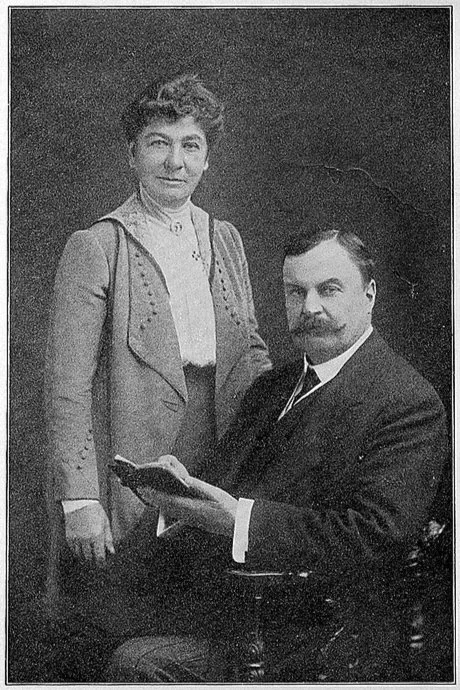
Major General Sir David Bruce and Lady Mary Bruce, unknown date, published in 1932
image credit: Wellcome Collection. CC BY 4.0.

Uganda, 1908. Left to right: Percival Mackie, Lady Mary Bruce, Sir David Bruce, H.R. Bateman, A.E.Hamerton
image credit: Wikimedia Commons, courtesy of Peter & Joanna Mackie