the woman who built the room she was never supposed to enter
Dr Florence Bascom
Before Florence Bascom could correct a hundred-million-year-old mistake in the geologic record, she had to sit behind a screen in class so she wouldn't distract the men.
But it was no small feat that Bascom was even allowed in the room in the first place.
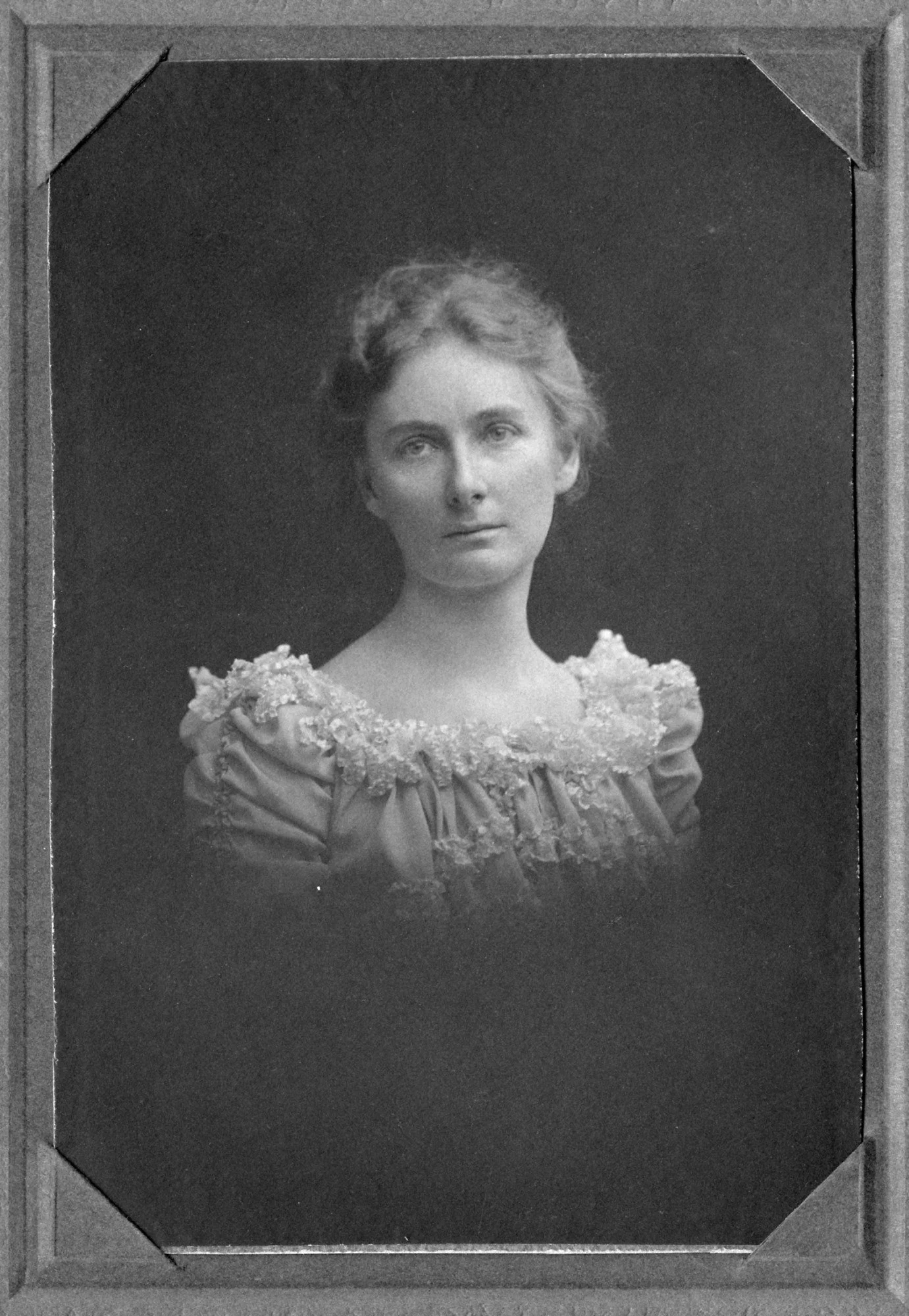
Florence Bascom (1862-1945)
Smithsonian Institution Archives, Accession 90-105, Science Service Records, Image No. SIA2007-0184
the “special students”
From its opening in 1876, the Johns Hopkins University and its president Daniel C. Gilman were not sympathetic to women. He suggested that women buy their way into the institution by forming their own coordinate college nearby, but then refused to let women take classes with the men.
Other schools found ways to let women in without really letting them in: separate classrooms, separate buildings, sometimes an entire coordinate college next door, so the appearance of access could be maintained without the substance of it. Geology at Johns Hopkins had no such room to maneuver. George Huntington Williams had built the department himself, and it was still, in practice, a one-man operation.
Despite the official policy of exclusion, a few women were admitted as "special students" in the 1870s and 1880s.
It was under just such status that in 1891 Bascom was admitted to Johns Hopkins to study geology, only the second woman at the school to receive the designation. In just one year, she had proved herself so helpful to Williams that he used her fieldwork in his reports to the Maryland Geological Survey. On the strength of that work, in 1892 Williams recommended Bascom admission to candidacy.
His recommendation was glowing, especially for the time, specifying that she had all the "ability, energy and enthusiasm that could be expected of any man". But beyond her brain, she had other leverage. She had the support of older professors who knew and spoke highly of Bascom's father, then the president of Williams College. Plus, her supporters argued that she would certainly be quickly hired by Bryn Mawr college as an instructor, so she was a very safe choice to make the exception.
a duty to both halves
Williams was the reason she'd come to Hopkins at all. He was part of a wave of young geologists who crossed the Atlantic to study at the University of Heidelberg, where Heinrich Rosenbusch was developing the field of petrography: studying rocks in slices thin enough to transmit light, identifying the minerals within by their optical properties. The students who trained at Heidelberg carried the technique home and fused it with the kind of fieldwork geology had always demanded, folding both into the wider science of petrology.
The person who brought that fusion back to Maryland, and to Johns Hopkins specifically was Williams. He insisted that a petrologist had a duty to also be a field geologist, studying rock in the laboratory only in light of what they had seen with their own eyes in the ground. He trained Bascom in both halves of the method, joining him and his students in the field around Baltimore, as she worked in long skirts and gaiters with a hammer and compass in her knapsack. On at least one occasion, when propriety made it unthinkable for Williams to take a single woman into the field alone, he brought his wife along as chaperone rather than leave Bascom behind.
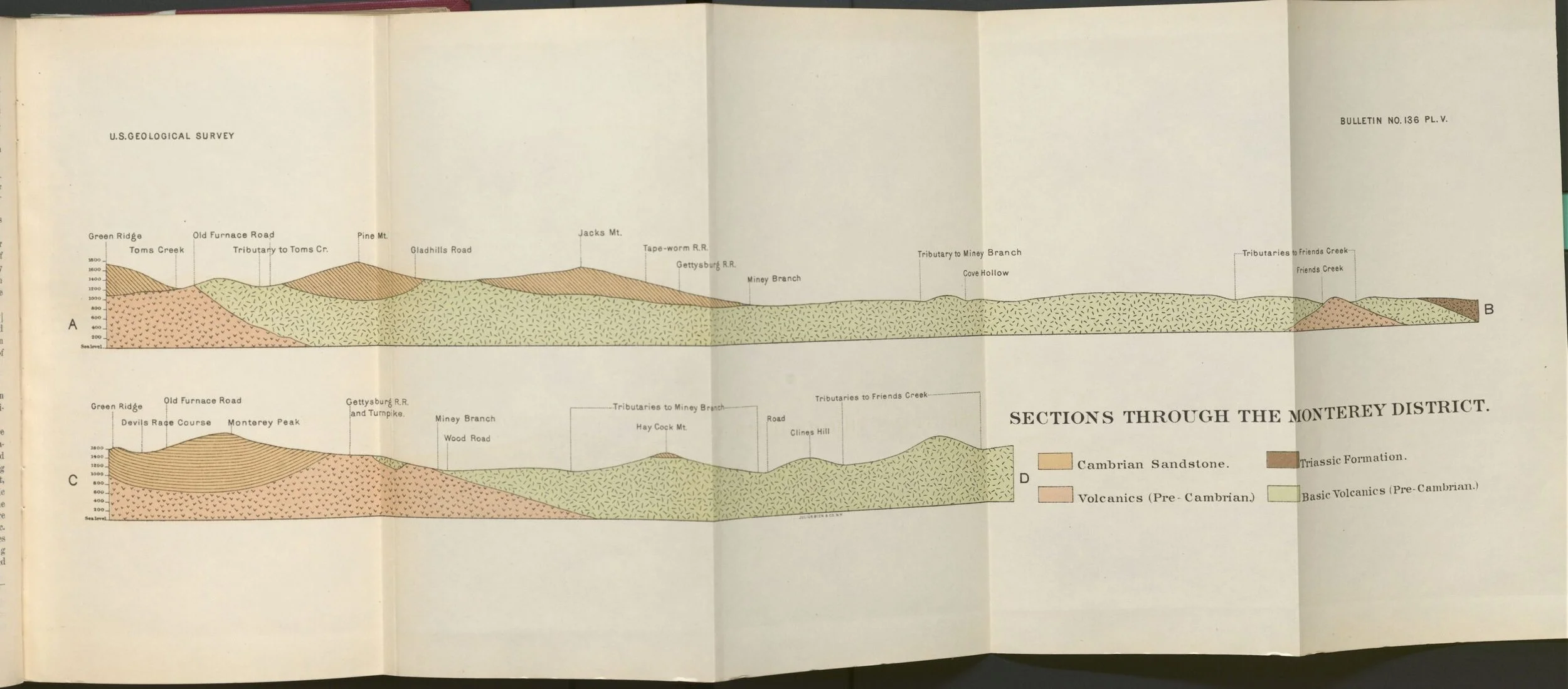
Sections through the Monterey District. USGS Bulletin 136. Florence Bascom. 1896. General Collections, Library of Congress.
a hundred million years of disguise
What Bascom produced from this work was a dissertation on the rocks of South Mountain, Pennsylvania. Using the combination of fieldwork and petrography, she proved that formations long classified as ancient sedimentary rock, the slow accumulation of deposited material, were instead the altered remains of volcanic lava flows. Millions of years of heat and pressure had transformed them into something that only looked, to an untrained eye, like it had settled quietly to a stream bed. It had taken the combination Williams trained into her, the field and the microscope together, to see what generations of geologists working from the outcrop alone could not.
In 1893, Bascom became the second woman in the United states to earn a doctorate in geology, and the first woman to receive a doctorate of from Johns Hopkins in any field.
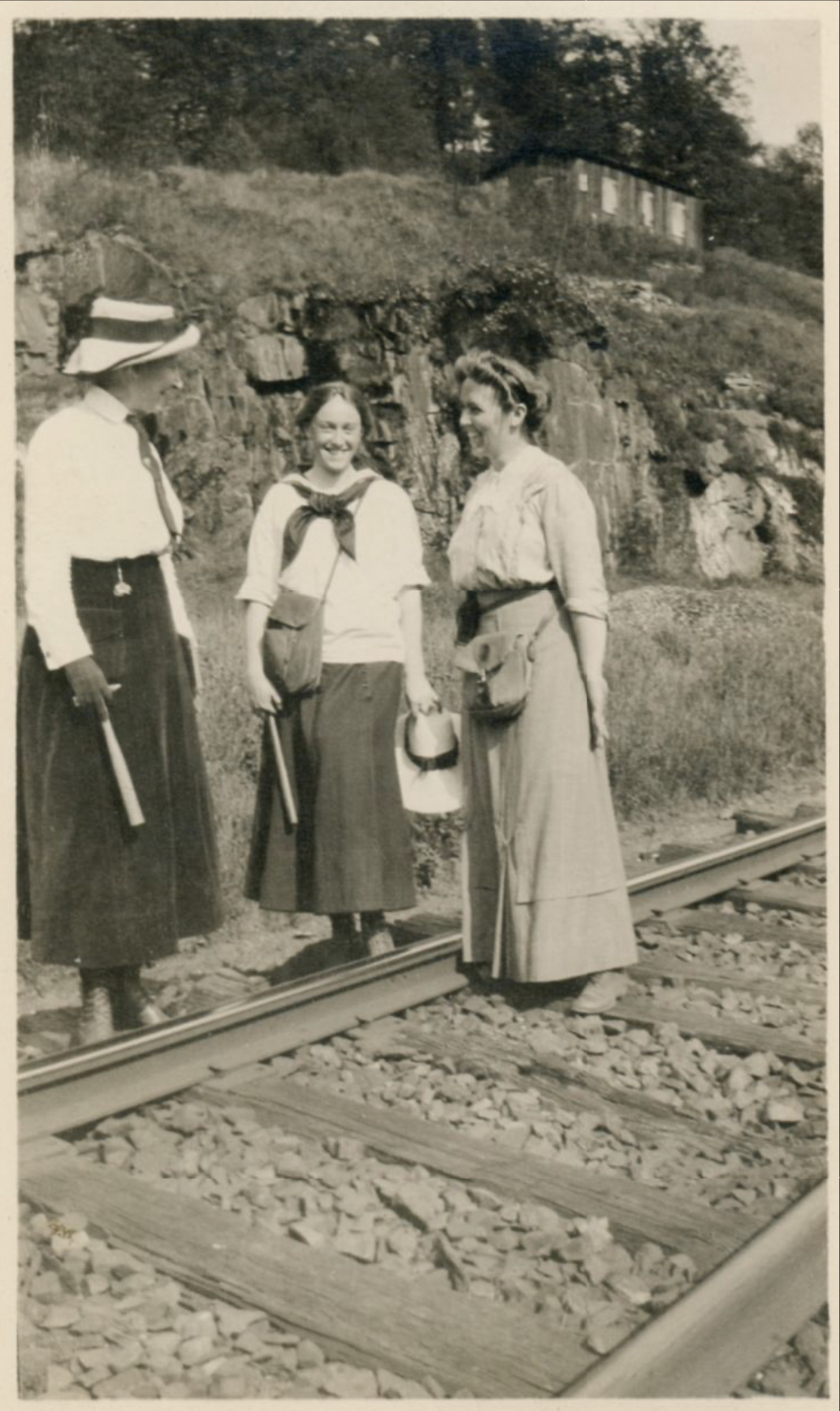
Florence Bascom (left) stands with Bryn Mawr College students Marina Ewald (center) and Laura Hatch (right) next to railroad tracks on a geology field trip. Image is a gift of Marina Ewald, German exchange student at Bryn Mawr College in 1912-1913.
Bryn Mawr College Photo Archives
what she built
After a short stint teaching at Ohio State, Bascom was recruited in 1895 to Bryn Mawr College to teach a single geology course. The following year, the USGS hired her, the first woman they'd ever appointed, to map the Piedmont across Maryland, Pennsylvania, and New Jersey.
For the next three decades, she juggled her mapping work, teaching, and building an entire department. In the summers, she spent her time in the field collecting and mapping, Then at the end of each season, she returned from mapping the Piedmont to the classrooms at Bryn Mawr, bringing her own fieldwork with her. Each year she had new material, new problems, new standards, and her students worked through real problems in something close to real time.
She built a curriculum that paired classroom instruction with serious field training, a laboratory space outfitted for petrographic work, and a research culture that treated her students as scientists in training rather than as women being humored with a science elective.
Bascom spent the rest of her career moving between these registers, the published science and the institutional infrastructure, as though they were the same project rather than separate obligations. She kept mapping for the USGS into her sixties. She kept teaching at Bryn Mawr until 1928. She was elected the vice president of the Council of the Geological Society of America in 1930. Her geologic folios of the Piedmont stayed in active use for decades after she stopped producing them, cited by geologists who had no reason to think about who'd made them. A glacial lake, an asteroid, and a crater on Venus have all been named in her honor.
inviting the legacy
What Bascom was able to build at Bryn Mawr is remarkable, with a lineage of students who became geologists, paleontologists, and petrologists in their own right. Eleanora Bliss Knopf became a leading authority on metamorphic rocks in New England, working in a direct extension of Bascom's own territory, Julia Gardner went on to a serious career in paleontology with the USGS, and Anna Jonas Stose spent decades mapping the structural geology of the Appalachians. This lineage is the output of a training program built deliberately by a woman who knew exactly what rigorous instruction looked like, because she had nearly been denied it herself.
The "special student" status didn't last. Christine Ladd-Franklin had been the first to hold it, finishing the work for her own doctorate in mathematics and logic in 1882. Johns Hopkins didn't award it to her until the university's fiftieth anniversary in 1926, a woman in her late seventies accepting a degree she'd earned forty-four years earlier. She died four years later, in 1930. Bascom outlived her by fifteen years, dying in 1945, twenty-five years before Johns Hopkins would let a woman in as an undergraduate at all.
But Bascom's legacy is still here. The Piedmont is still there, the same rock she spent a career reading, still telling the story she was the first to read correctly. So is the department she built at Bryn Mawr, which trains generations of women geologists long after she was gone.
Bascom, F., Darton, N.H., Clark, W., Kuemmel, H., Miller, B., and Salisbury, R., 1909, Trenton folio, New Jersey-Pennsylvania: U.S. Geological Survey Folios of the Geologic Atlas 167, 1 atlas (24 p., [4] leaves of plates) : ill., 3 maps ; 55 x 47 cm., https://doi.org/10.3133/gf167.