the woman who dated the galaxy
Dr Nancy Grace Roman
Call her the Mother of Hubble if you want.
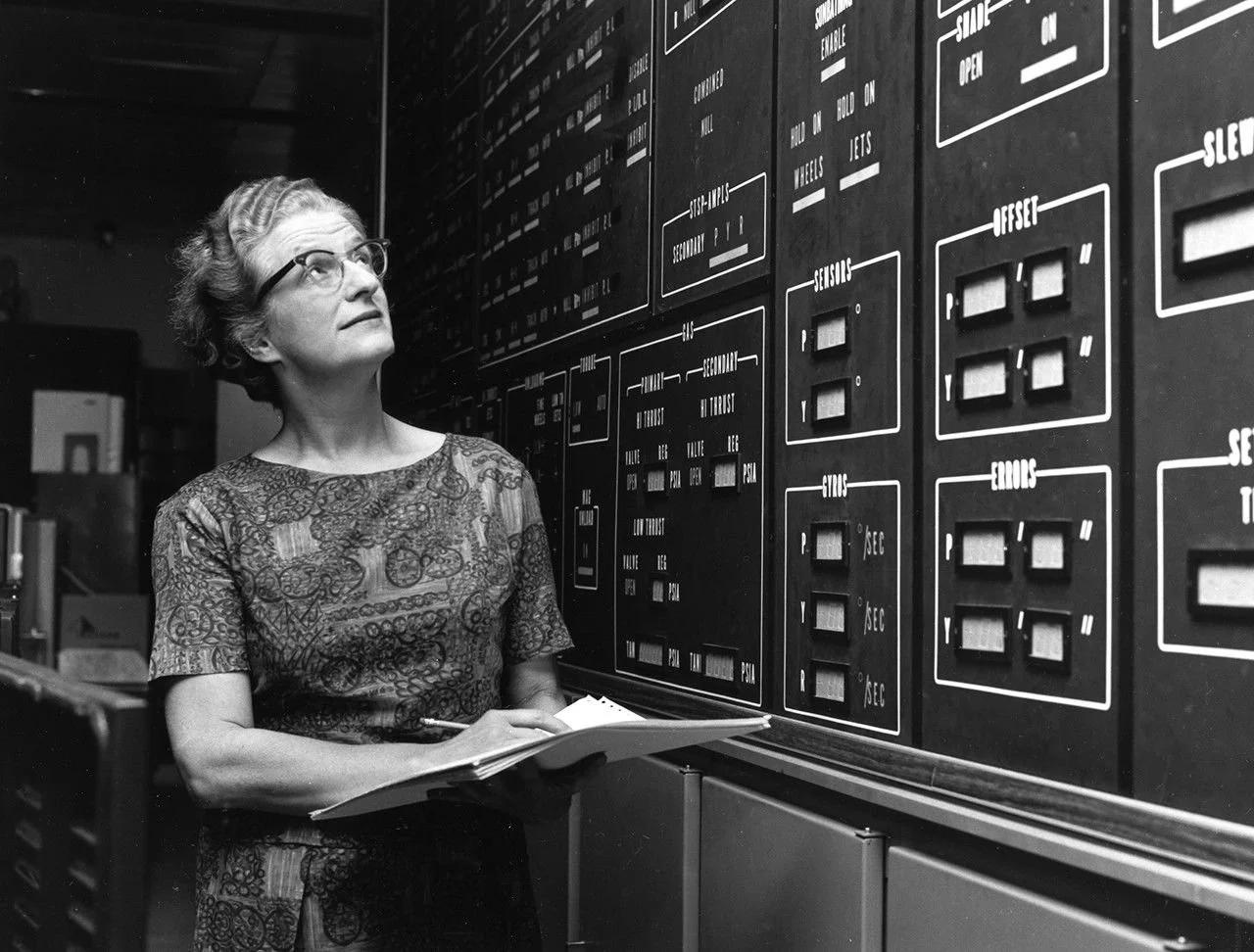
Nancy Grace Roman ca 1972
image credit: NASA
She spent years convincing skeptical astronomers and Congress that putting telescopes above the atmosphere was worth doing, built the grant programs, and made Hubble possible. But the telescope launching this August carries her name for reasons that go beyond that. The mission itself is the continuation of her science, and the reason the instrument belongs to her in more than name.
Framing her as the Mother of Hubble is not wrong so much as it is a category error. It takes a brilliant scientist and turns her into a patron, crediting her for enabling someone else's instrument rather than for her own ideas.
What Roman actually did at NASA was build the institutional architecture of American space astronomy from scratch. She looked at her options of either fighting for observation time on one telescope, or building the entire system that would put observatories in orbit for everyone who came after, and she chose the higher-leverage move. It cost her her own observing career, but she knew that going in.
What that story leaves out is the most interesting part: before she built the architecture, she built the foundation.
metals and movement
In 1950, Roman published her groundbreaking study under a very skimmable title: "A Correlation Between the Spectroscopic and Dynamical Characteristics of the Late F- and Early G-Type Stars." But it's one of the foundational observations in how we understand our galaxy.
She proved that stars betray their age through their chemistry, and they betray their chemistry through how they move.
Roman had been measuring the metal content of sun-like stars, elements heavier than hydrogen and helium which is forged by fusion in stellar cores and scattered when those stars die. The universe's first stars were almost entirely hydrogen and helium, and each successive generation inherits a slightly richer and more metallic mix from the debris of its predecessors. The lower the metallicity of a star, the older the star.
Identifying metallicity from a star's spectrum was already possible, thanks to Cecilia Payne-Gaposchkin, who had cracked stellar composition twenty-five years earlier by showing that spectral lines could be precisely decoded once you accounted for temperature. Roman built on what came before her, and took to exploring what a star’s chemistry reveals about when they formed and where they have been.
When she mapped the metal-poor, older stars against their trajectories through the galaxy, she found a clear pattern. Ancient stars moved fast, with wild, tilted, and elongated orbits, and younger stars moved on steady, near-circular paths, gliding along a flat disk. Roman found the connections between chemistry and motion. A star's orbit is the record of the conditions it was born into billions of years ago.
movement and evolution
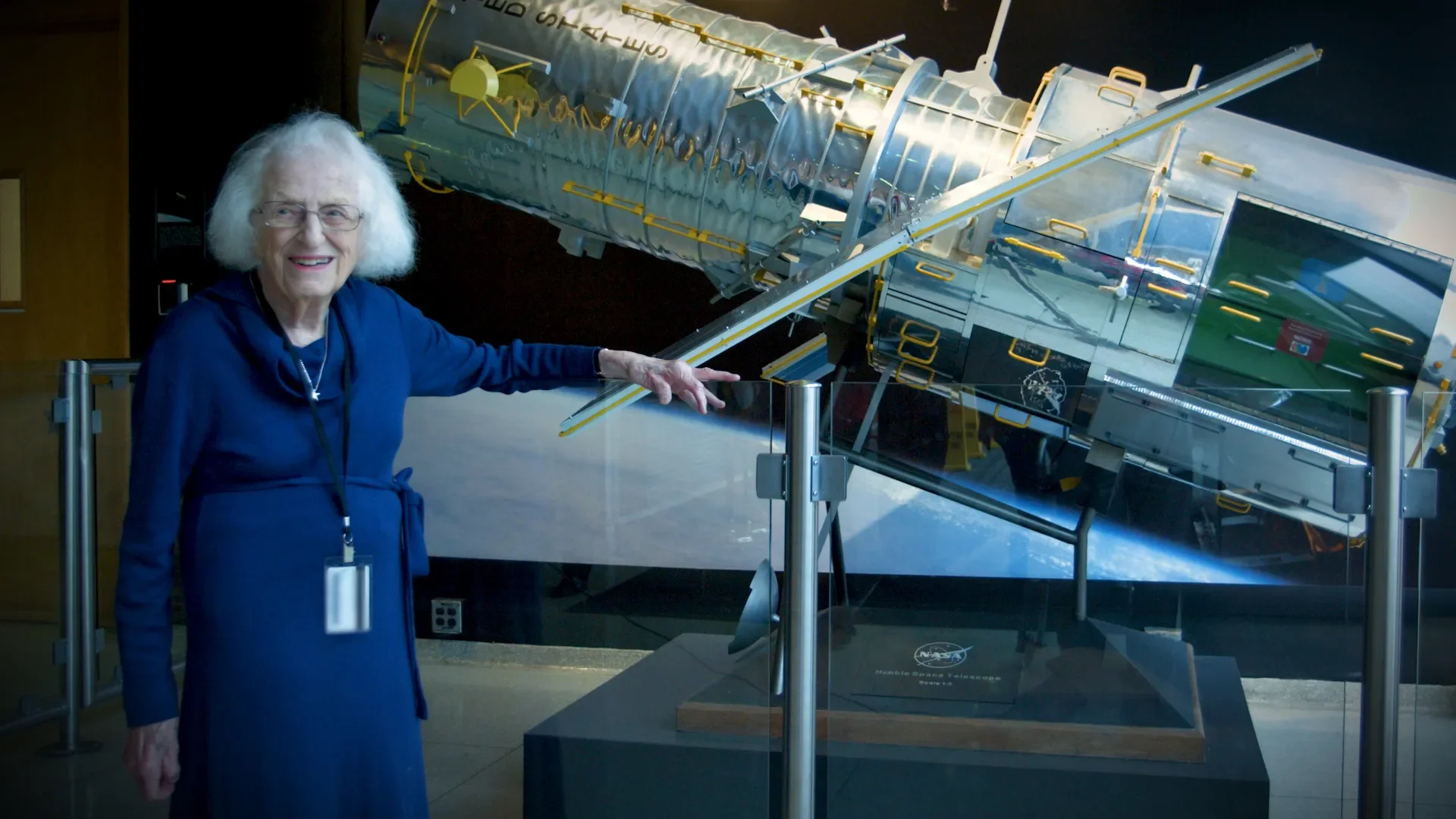
Nancy Grace Roman with a model of the Hubble Space Telescope.
image credit: NASA
If chemistry predicts motion and motion records history, then a snapshot of the stars right no can tell you the history of the formation of the entire galaxy. Roman catalogued roughly 600 of these high-velocity, metal-poor stars and handed the field a methodology for a brand new discipline.
In 1962, astronomers Olin Eggen, Donald Lynden-Bell, and Alan Sandage used exactly Roman's chemistry-and-orbit relationship and other lines of evidence to argue that the Milky Way formed in a rapid collapse: the oldest, metal-poor stars were set into their wild orbits early, before the remaining gas settled into the rotating disk we live in today. Their paper describing the “ELS model” is still a pillar of cosmology, and Roman's 1950 observation is one of the load-bearing beams inside it.
Seventy-five years later, Roman's paper is still working reference in a very active field. The European Space Agency's Gaia mission spent over a decade mapping the positions, motions, and chemistry of nearly two billion stars before its decommissioning in March 2025. And a 2025 paper using ESA’s Gaia data cites Roman 1950 as the origin of the insight that metal-poor stars are the fast-moving ones. Gaia's own archive is far from finished; a fourth major data release is expected by the end of 2026. While Gaia may be gone, the work will continue for decades. Most prize-winning science doesn't stay useful as long as Roman's has.
from observations to strategy
What happened next to Roman is a familiar and dispiriting story. Yerkes Observatory would not give a woman a permanent position, so in 1954 she moved to the Naval Research Laboratory, where the instruments available to her were inadequate for the radio astronomy she wanted to pursue. She was a working scientist being slowly squeezed out of doing science.
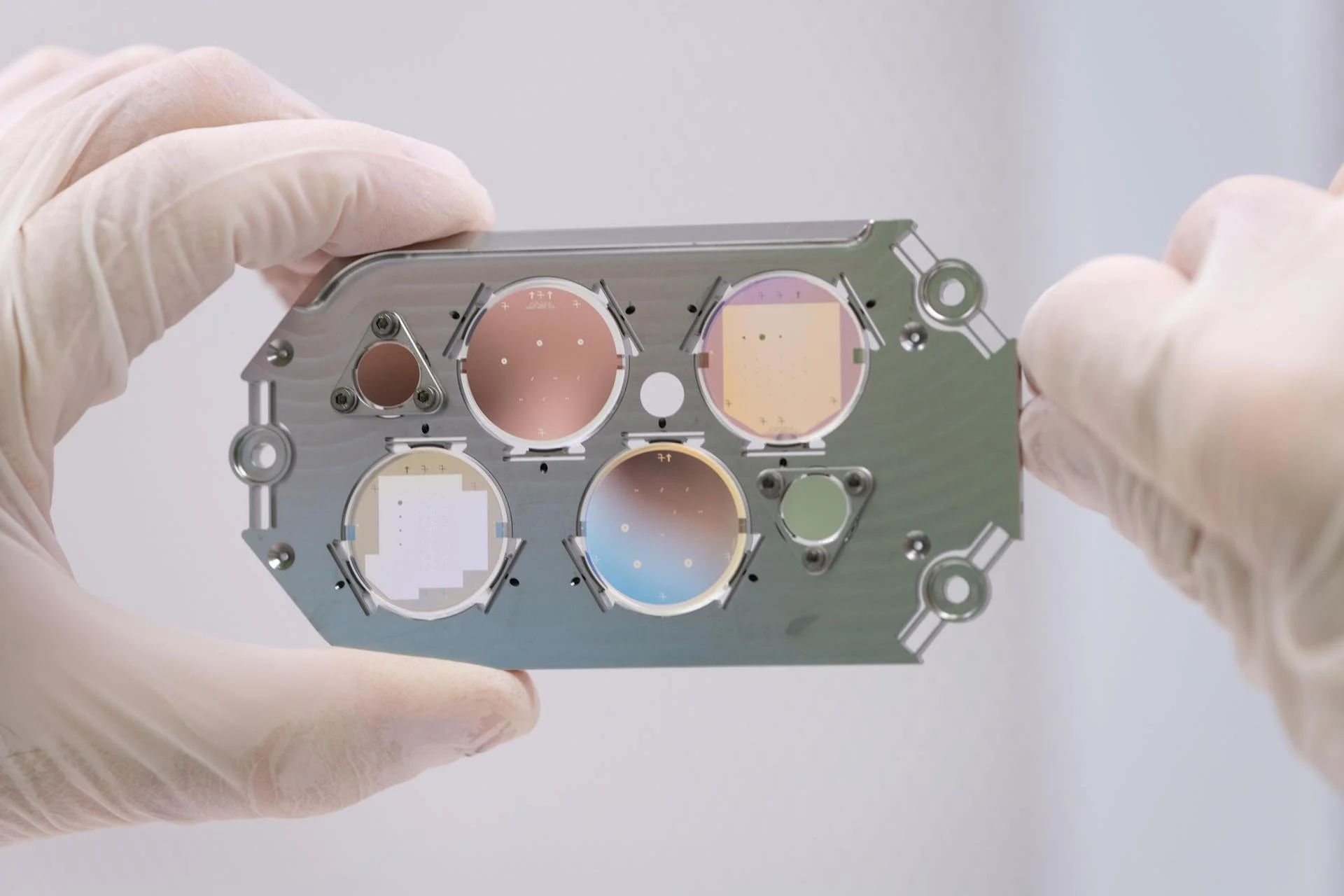
“The focal plane mask for the Coronagraph Instrument on NASA's Nancy Grace Roman Space Telescope, shown here, is one of the components used to suppress starlight and reveal planets orbiting a star. Each circular section contains multiple "masks" – carefully engineered, opaque obstructions designed to block starlight. Some masks are about the width of a human hair.”
image credit: NASA/JPL-Caltech
In February 1959, Roman joined the newly formed NASA as Head of Observational Astronomy. Seven months later she stood up at the American Astronomical Society and presented a paper called "Planets of Other Suns." Other planets were an old philosophical idea, but in 1959 they were not a serious scientific program. Detection was considered essentially impossible, and the field had little appetite for arguing otherwise, but Roman did. Her spectroscopic work had given her a precise understanding of what the atmosphere does to starlight, and she had identified exactly where it became a hard ceiling. The brightness difference between a star and any planet orbiting it is so extreme that atmospheric scattering drowns the signal entirely. She even sketched a possible approach called a coronagraphic mask, which rotates to block the host star's light directly, leaving the planet signal exposed. A version of that technique would eventually fly on Hubble, and it will fly again on the telescope that carries her name. The problem that instrumentation couldn’t compensate for the atmosphere when the differences they needed to track were so precise. They needed to build a whole new infrastructure that would let everyone else see what she already understood was waiting above the atmosphere.
By 1960, Roman was Chief of Astronomy, the first woman to hold an executive position at the agency, and she would spend the next two decades making exactly that argument to scientists, to Congress, and to anyone with a budget. She traveled the country giving lectures at astronomy departments, finding out what researchers wanted to study and making the case for what observing from space would unlock. She built the grant programs, shepherded the Orbiting Solar Observatories, and pushed for the International Ultraviolet Explorer, which she later called her greatest success. And she drove the early planning for what was then called the Large Space Telescope, the project that later became Hubble. She retired in 1979, staying on just long enough as a consultant to complete the selection of the Space Telescope Science Institute and safely hand it off to a trusted colleague. Hubble launched in 1990. She was in the audience in 1994, knitting in the back of the room, when NASA announced the fix for its famously flawed mirror.
her legacy
That's the work behind the nickname. People call her the "Mother of Hubble," a phrase coined by her NASA colleague Ed Weiler, and it’s well earned. Without Roman spending years crisscrossing the country selling skeptical astronomers on the idea of space telescopes, building the grant programs, and convincing Congress to pay for it, Hubble might not exist. But "mother of" is a quietly diminishing frame. It casts her as the nurturing enabler of someone else's instrument, when the truer description is architect. She designed the institutional plumbing of American space astronomy. She just did it knowing her own name might not end up on the marquee.
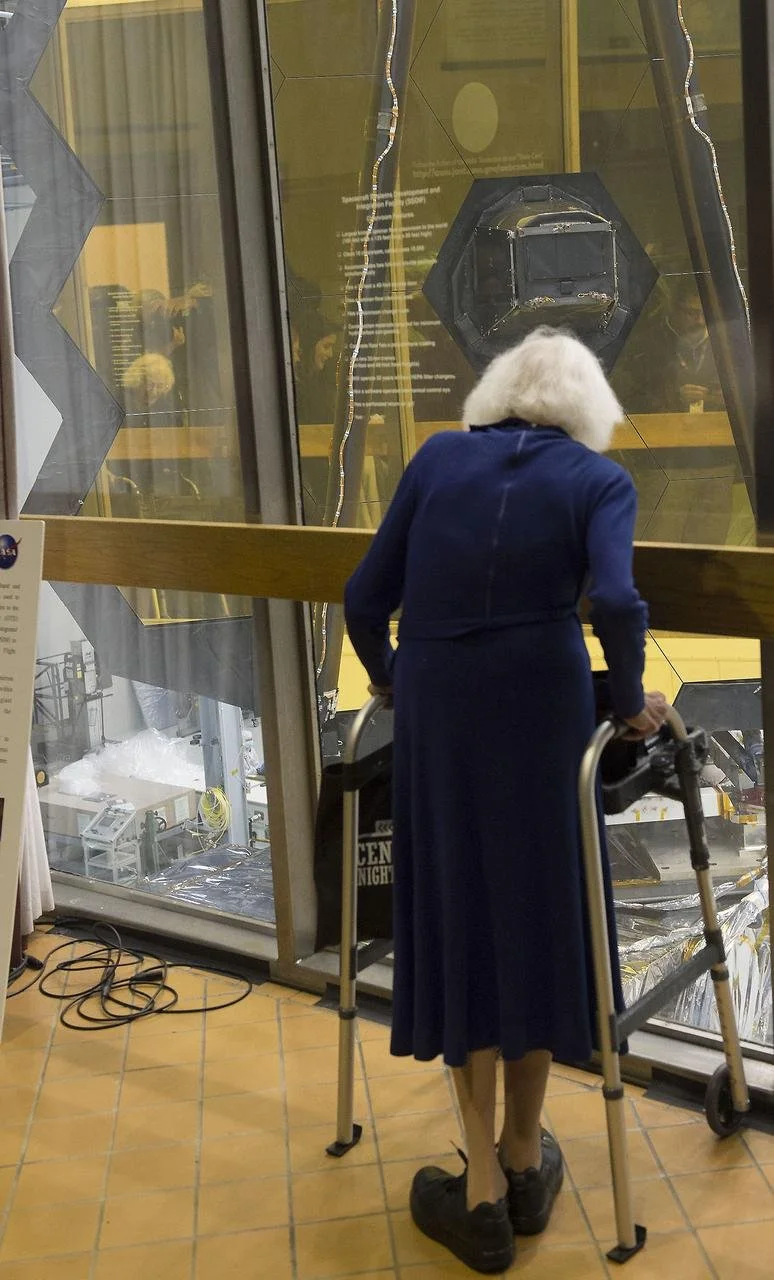
Nancy Grace Roman viewing the James Webb Space Telescope, March 21, 2017.
image credit: Debora McCallum/NASA
Roman died on December 25, 2018. Two years later, NASA renamed the Wide Field Infrared Survey Telescope the Nancy Grace Roman Space Telescope. It would be easy to see a plaque on a machine as simply a gesture to honor a great woman in the history of NASA. But that would miss the fact that the Roman Space Telescope is a continuation of Roman’s own work.
Roman Space Telescope will have Hubble-sharp vision across a field of view roughly a hundred times wider than Hubble has. It is, fundamentally, a survey instrument, characterizing enormous numbers of stars and galaxies at once to find the rare and the revealing among them. In other words, Roman’s own method.
The mission of Roman Space Telescope is a microlensing campaign expected to discover thousands of exoplanets, the very thing she theorized about in 1959. It is also going to tasked with mapping how the universe has expanded across cosmic time, reading the deep history of everything. Roman’s own methods again.
She found the oldest stars by reading their chemistry and motion. Now the telescope that carries her name is about to go looking for other worlds and the history of the cosmos, doing her kind of science, on a scale she could only have dreamed about, after she's gone.
They didn't put her name on it to just to be kind. They put her name on it because it's hers.