the woman who decoded the sun
Dr Cecilia Payne-Gaposchkin
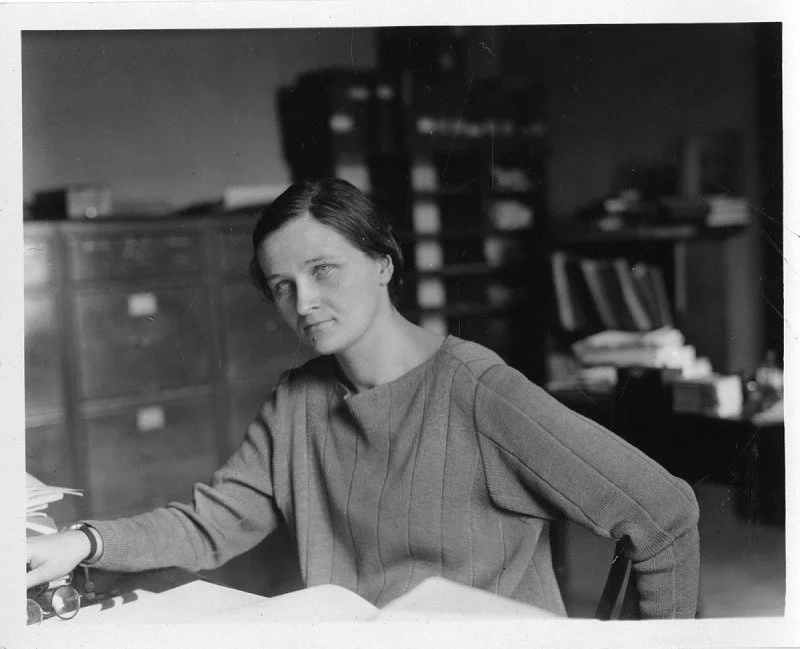
Cecilia Payne-Gaposchkin at her desk at Harvard.
Smithsonian Institution Archives, Accession 90-105, Science Service Records, Image No. SIA2009-1326
In 1925, a doctoral student at Harvard submitted a thesis that identified the most abundant elements in the Sun and, by extension, the universe. The field's arbiters told her it was almost certainly wrong, and she walked it back. But she was right. And it took four years for the field to catch up to her.
Cecilia Payne-Gaposchkin's story follows a pattern that repeats itself across the history of science. A researcher, working beneath the field's power structure, produces a result so foreign to the prevailing framework that the field's gatekeepers couldn't (or wouldn't) accept it at first. What makes Payne-Gaposchkin's case notable is that her discovery wasn't subtle. She had determined that the dominant assumption about what the universe is made of was wrong by a factor of a million.
solving a problem
By the early twentieth century, astronomers had access to the characteristic patterns of absorption lines that appear when starlight passes through a prism, called stellar spectra. Because each element absorbs light at specific wavelengths, deciphering stellar spectra can help decipher what a star is made of. The challenge was reading them correctly.
The prevailing assumption, based on the intensities of each line, was that stellar composition was broadly similar to Earth's, with heavy elements like iron, silicon, and calcium predominating. The stellar spectra from the Sun seemed to be iron-dominant. And since we know that the Sun and Earth had to have formed from the same primordial materials, we assumed their compositions wouldn't differ dramatically. Over time, those assumptions had calcified into fact.
The flaw in this reasoning was not in the spectral observations themselves, but in their interpretation. The intensity of a spectral line is a function of both elemental abundance and temperature, and at stellar scales, temperature dominates. At the extreme temperatures found in stellar atmospheres, atoms are ionized (electrons are stripped away) and ionized atoms produce different spectral signatures than neutral ones. An element could be overwhelmingly abundant but nearly invisible in a spectrum if conditions weren't right for the neutral form to produce strong lines.
breakthroughs at Harvard
Payne arrived at Harvard Observatory in 1923, after completing her studies at Cambridge. Under Harlow Shapley, a supportive mentor who recognized her ability early, she gained access to the most extensive collection of stellar spectra in the world. That dataset was itself the product of foundational work by Annie Jump Cannon, whose systematic classification of hundreds of thousands of stars through the Henry Draper Catalogue had given the field its organizational backbone.
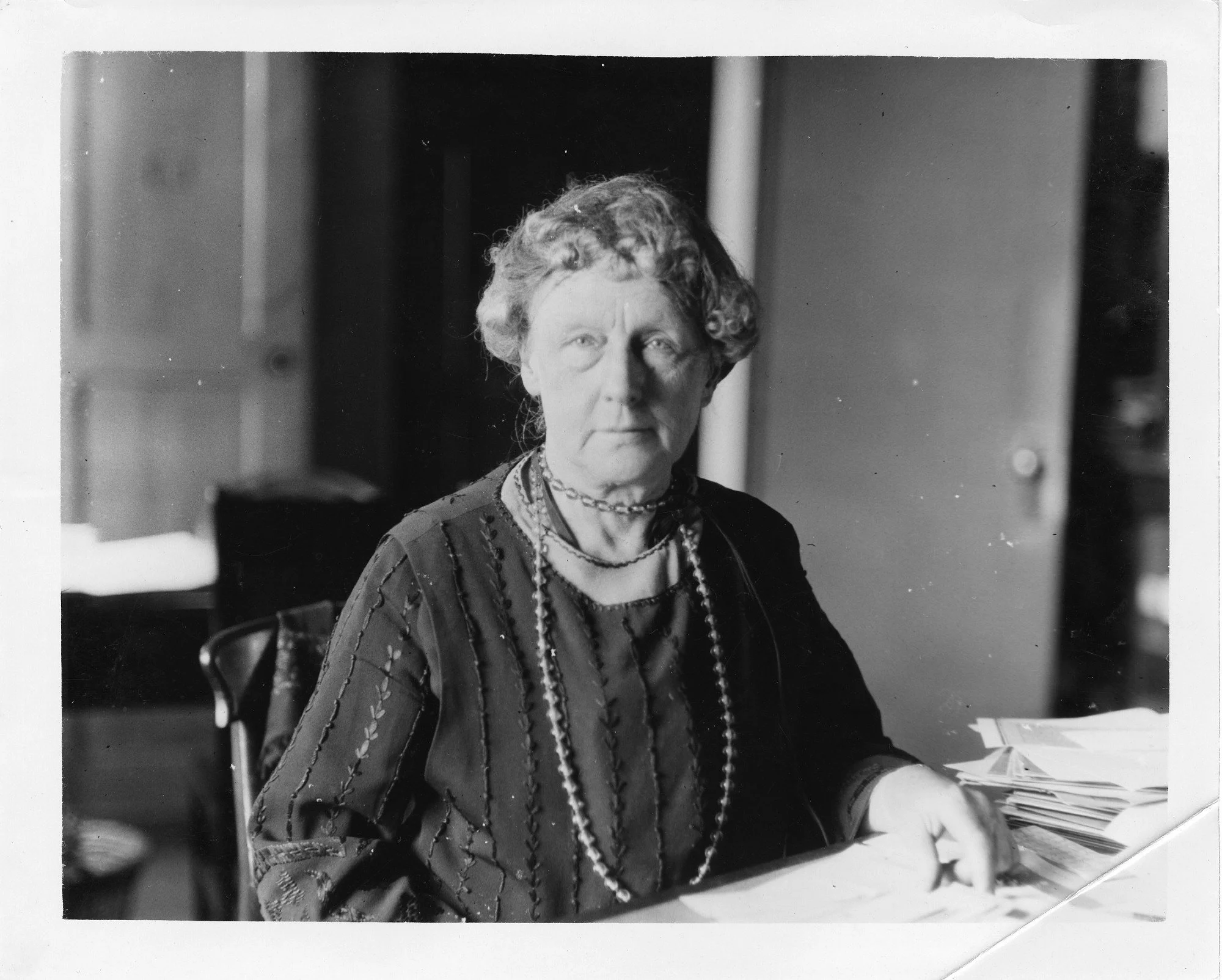
Annie Jump Cannon (1863-1941) at the Harvard College Observatory.
Smithsonian Institution Archives, Accession 90-105, Science Service Records, Image No. SIA2008-0646
She also had access to something newer. Meghnad Saha, an Indian physicist, had published his ionization equation in 1920, which describes mathematically how temperature and pressure govern the ionization states of atoms. For the first time, astronomers had a principled way to move from "what lines do we see" to "what is actually there." Payne applied Saha's equation systematically across the full range of Cannon's stellar types, using spectral line behavior to determine temperature and working backward to infer elemental abundances. Her analysis was meticulous and her conclusion was unambiguous.
the field had it backwards
Hydrogen and helium were not minor constituents of the Sun but its overwhelmingly dominant component. Hydrogen alone was approximately one million times more abundant than the heavy elements that had been assumed to predominate, and those heavy elements were the trace components. The Sun, and therefore most stars, was almost entirely hydrogen and helium.
This was a fundamental revision of our understanding of the universe. It was also initially rejected.
Henry Norris Russell, co-creator of the Hertzsprung-Russell diagram and one of the era's most authoritative voices, told her the hydrogen abundance result was impossible, likely an artifact of the analysis. Payne added a line to her thesis describing the result as "almost certainly not real."
Her thesis, Stellar Atmospheres, was submitted in 1925 to Radcliffe College, since Harvard did not grant doctoral degrees to women. The thesis did not refine existing models. It invalidated their central assumption, derived from first principles, using tools that had only recently become available. It is still widely regarded as one of the finest doctoral theses ever produced in the field of astronomy.
Russell published his own analysis four years later, reaching the same conclusion. Payne's original derivation was footnoted. The field accepted the conclusion largely based on his authority.
later career
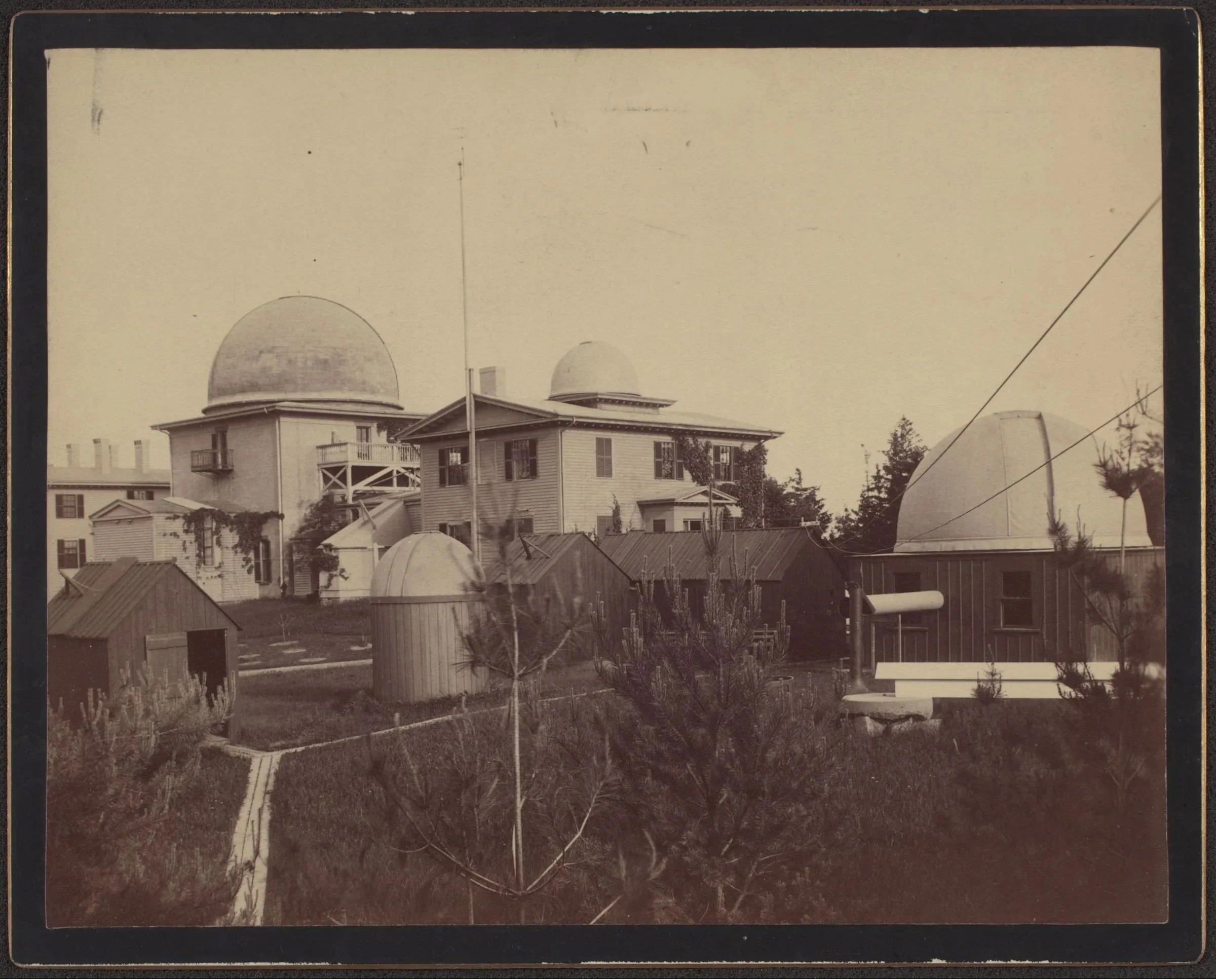
The Harvard College Observatory, ca 1886.
Harvard University Archives / UAV 630.271 (278). Harvard Libraries.
Payne's institutional advancement moved slowly relative to her output. She spent years at Harvard Observatory without faculty standing, working as a technical assistant and researcher. Harvard did not grant her a formal faculty appointment until 1938, and she was not made full professor until 1956, becoming the first woman to hold that rank in Harvard's Faculty of Arts and Sciences. She chaired the astronomy department from 1956 to 1960, the first woman to chair any Harvard department.
After marrying Russian astrophysicist Sergei Gaposchkin in 1934, she collaborated with him extensively on variable star research, producing systematic catalogs that remained standard references for decades. She also became the first recipient of the Annie Jump Cannon Award in Astronomy, a fitting close to a thread that had run through her career since she first sat down with Cannon's dataset.
her impact
The discovery that the universe is predominantly hydrogen is foundational to everything that follows in stellar physics. At the extreme heat and pressure found at the core of stars, hydrogen fuses into helium, and from there into the heavier elements, the carbon, oxygen, iron, and silicon that make up planets and, eventually, us.
The entire framework of stellar evolution, how stars ignite, how long they burn, how they die, is built on hydrogen abundance. So is our understanding of the large-scale structure and chemical history of the universe.
The predicted ratio of hydrogen to helium coming out of the Big Bang, one of the cornerstones of modern cosmology, only means something because we can measure those abundances in stars and confirm the match. Theories of how stars are born, age, and seed the universe with heavier elements all run on the same foundation. The surveys of stellar populations that Nancy Grace Roman would later build on depended on the ability to read stellar composition from spectra with quantitative precision.
Payne proved that it all could be done.
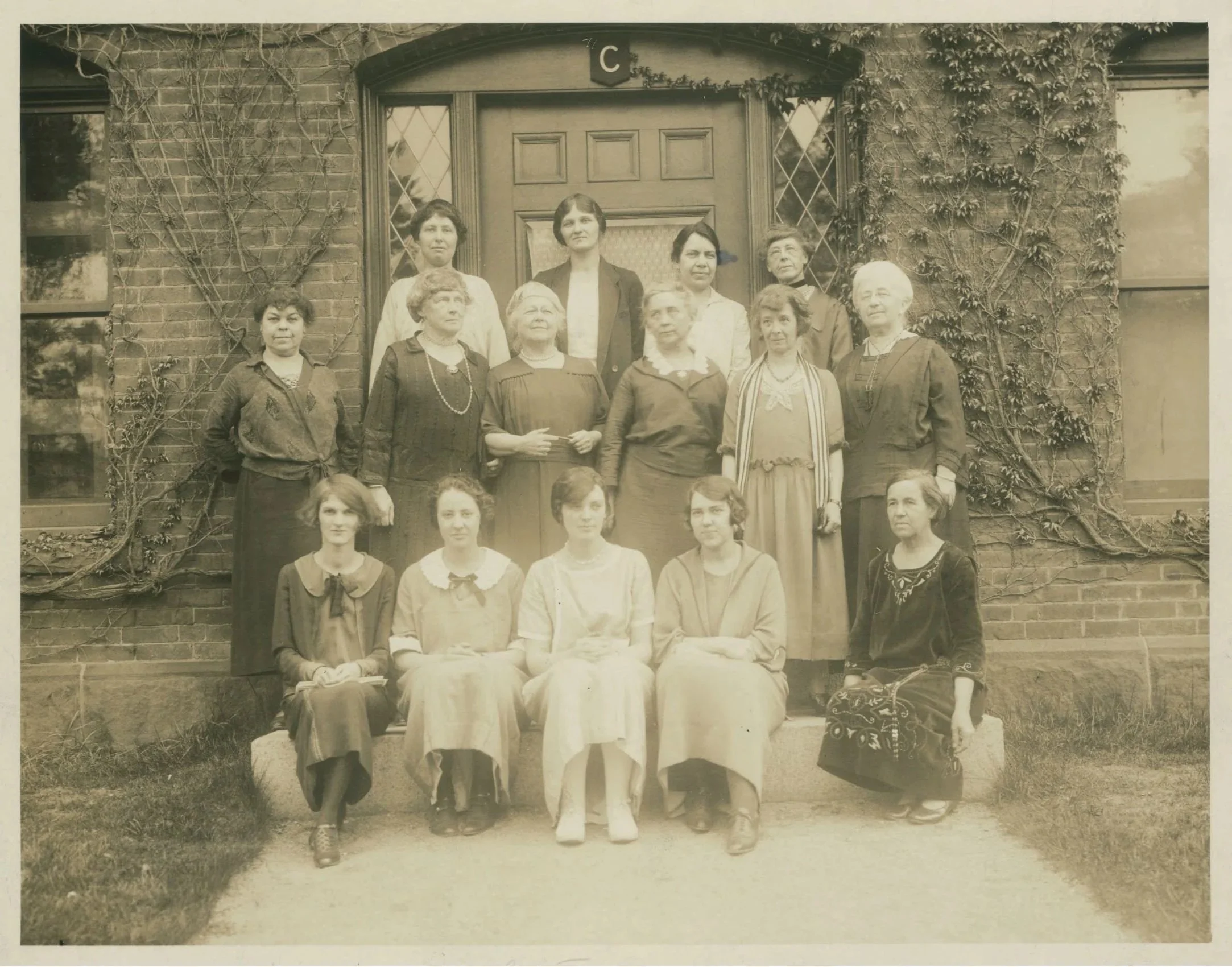
“As We Were”, The Women of the Harvard College Observatory, 1925.
left to right:
Back row: Margaret Harwood, Cecilia Payne (later Payne-Gaposchkin), Arville D. Walker, Edith F. Gill
Middle row: Lillian L. Hodgdon, Annie J. Cannon, Evelyn F. Leland, Ida E. Woods, Mabel A. Gill, Florence Cushman
Bottom row: Agnes M. Hoovens, Mary B. Howe, Harvia H. Wilson, Margaret Walton (later Mayall), Antonia C. Maury
Harvard University Archives / HUPSF Observatory (19). Harvard Libraries